
What Is FastAPI and Why Is It a Good Choice for Python Backends?
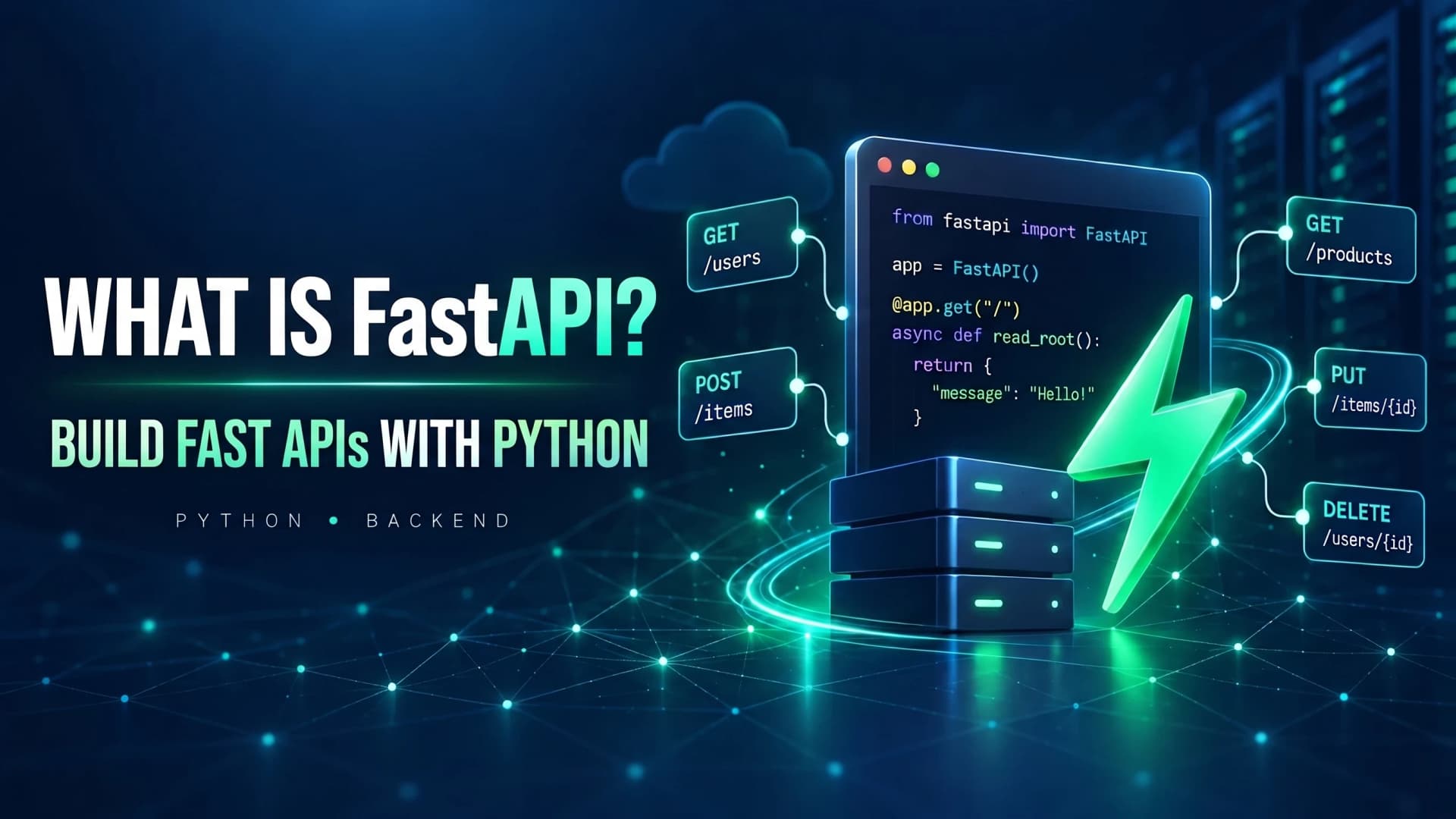
If you need to build a fast, readable, and maintainable API in Python, FastAPI is one of the strongest options available. It uses standard Python type hints to validate input, generate API documentation automatically, and keep the contract between your code and its consumers clear.
The short answer: FastAPI is a modern, open-source Python framework for building APIs and backend services. It is built around the ASGI standard, supports asynchronous programming, and combines Starlette and Pydantic to provide a direct path from endpoint definitions to data validation and OpenAPI documentation.
FastAPI is not meant to replace every backend tool. It is particularly effective for modern APIs, independent services, and systems where a clear data contract and efficient I/O handling matter.
What is FastAPI?
FastAPI is a Python web framework focused on building APIs. Its first public release appeared in 2018. Routes are declared with simple decorators, while request and response structures are described with the same type hints already used in modern Python code.
The following example creates a small API with two endpoints:
from fastapi import FastAPI

app = FastAPI(title="My First API")


@app.get("/")
async def root():
    return {"message": "API is running"}


@app.get("/users/{user_id}")
async def get_user(user_id: int):
    return {"user_id": user_id}
The second route declares user_id as an integer. If a client sends a value such as abc, FastAPI rejects the request before calling the function and returns a structured validation error. The same type declaration also appears in the generated API documentation. One small piece of information therefore serves runtime validation, editor tooling, and documentation at the same time.
After running the application, FastAPI normally exposes three useful endpoints:
/docsprovides Swagger UI for exploring and calling the API./redocpresents an alternative documentation interface through ReDoc./openapi.jsonexposes the machine-readable OpenAPI contract.
This behavior is part of the official FastAPI first-steps guide and gives backend, frontend, QA, and integration teams a shared contract.
How does FastAPI work?
FastAPI builds much of its functionality on two established Python libraries: Starlette for the web layer and Pydantic for data handling. It connects those components with Python type hints, dependency injection, and the OpenAPI standard.
Starlette and ASGI
Starlette is a lightweight ASGI framework that provides routing, middleware, WebSockets, streaming responses, cookies, sessions, and background tasks. FastAPI is a subclass of Starlette, so Starlette features remain available inside a FastAPI application.
ASGI stands for Asynchronous Server Gateway Interface. It defines how Python web applications communicate with compatible servers such as Uvicorn. Unlike the older WSGI model, ASGI was designed to support asynchronous workloads, long-lived connections, and protocols such as WebSockets.
Pydantic and data validation
Pydantic creates data models from Python type hints. Imagine a registration endpoint that accepts a user's name, email address, and age:
from typing import Annotated

from fastapi import FastAPI
from pydantic import BaseModel, EmailStr, Field

app = FastAPI()


class UserCreate(BaseModel):
    name: Annotated[str, Field(min_length=2, max_length=80)]
    email: EmailStr
    age: Annotated[int, Field(ge=13, le=120)]


@app.post("/users", status_code=201)
async def create_user(payload: UserCreate):
    return payload
This model rejects a name shorter than two characters, an invalid email address, or an age outside the defined range. FastAPI returns the field-level errors as structured JSON without requiring a separate collection of manual if statements.
Input validation does not make an application secure by itself. Authorization, rate limiting, secret management, protection against SQL injection, and security monitoring still require deliberate design.
Why is FastAPI a good choice for Python backends?
FastAPI addresses several recurring backend concerns in one consistent model: parsing and validating data, producing responses, documenting the API contract, managing dependencies, and working with asynchronous code. The main benefit is not merely fewer lines of code. It is the reduced distance between the declared contract, the generated documentation, and the behavior clients actually receive.
Fast development with standard type hints
FastAPI does not require a separate schema language for everyday data definitions. Standard types such as str, int, list, dict, and datetime, along with Pydantic models, are understood by both the framework and modern Python tooling.
This provides practical benefits:
- Better autocomplete and earlier error detection in an IDE
- Function signatures that communicate their intent clearly
- Less manual conversion between JSON and Python objects
- Greater consistency between code and API documentation
- The ability to generate clients for other languages from OpenAPI
Type hints do not replace tests, but they make many incorrect assumptions visible earlier in the development cycle.
Interactive documentation without a separate maintenance burden
Documentation maintained independently from an implementation eventually becomes outdated. FastAPI derives path, parameter, request body, response model, and security-scheme information from the application and records it in OpenAPI.
This is especially helpful when frontend and backend development happen in parallel. A frontend developer can inspect an endpoint, see its expected payload, and call it from the browser before the full interface is complete. Still, generated schemas cannot explain every business rule. Useful examples, error scenarios, and domain-specific behavior should be documented intentionally.
First-class support for async and await
A backend spends much of its time waiting for databases, remote APIs, networks, or files. For these I/O-bound workloads, asynchronous code allows the application to make progress on other requests while one operation is waiting.
import httpx
from fastapi import FastAPI

app = FastAPI()


@app.get("/exchange-rate")
async def get_exchange_rate():
    async with httpx.AsyncClient() as client:
        response = await client.get("https://example.com/api/rate")
        response.raise_for_status()
        return response.json()
A useful rule is straightforward: if a library asks you to call it with await, define the endpoint with async def. When a library performs blocking I/O and has no asynchronous interface, a regular def path operation can be appropriate because FastAPI runs it in a thread pool. The official FastAPI async guide explains this behavior in detail.
asyncdoes not automatically make CPU-intensive work faster. Image processing, large cryptographic operations, video encoding, and other CPU-bound tasks usually belong in a separate worker, task queue, or parallel processing system.
Built-in dependency injection
FastAPI's dependency injection system helps share concerns such as database sessions, authentication, authorization, and application settings. Dependencies can depend on other dependencies, and FastAPI coordinates their execution and cleanup.
from typing import Annotated

from fastapi import Depends, FastAPI, Header, HTTPException

app = FastAPI()


async def require_api_key(x_api_key: str = Header()):
    if x_api_key != "replace-with-a-secret":
        raise HTTPException(status_code=401, detail="Invalid API key")
    return x_api_key


@app.get("/dashboard")
async def dashboard(api_key: Annotated[str, Depends(require_api_key)]):
    return {"authenticated": True}
This snippet only demonstrates dependency injection. A production secret should never be hard-coded in source code. Environment variables or a dedicated secret manager are safer choices.
A solid foundation for high-traffic APIs
ASGI and non-blocking I/O make FastAPI a good foundation for many high-traffic APIs. Framework choice, however, is only one part of performance. An inefficient database query, a missing cache, a slow upstream service, excessive logging, or an unsuitable worker configuration can make any application slow.
Instead of treating “fast” as a guarantee, benchmark the endpoints, datasets, database, and traffic patterns that resemble the real product. FastAPI provides strong performance characteristics, but architecture and measurement remain the engineering team's responsibility.
Which projects are a good fit for FastAPI?
FastAPI offers the most value when an API is central to the product or when a service must communicate with several different clients.
Common use cases include:
- REST APIs for web and mobile applications
- A standalone backend for React, Next.js, or Vue
- Authentication and user-management services
- Small, contract-driven microservices
- Serving machine-learning and AI models through an API
- Receiving payment, messaging, and automation webhooks
- Real-time systems built with WebSockets or streaming
- Internal dashboards and API-based business tools
In a Next.js project, for example, Next.js can render the interface while FastAPI owns business rules, persistence, authentication, and the public API. This separation allows both parts to be developed independently and, when necessary, scaled with different infrastructure.
FastAPI vs Django vs Flask
FastAPI, Django, and Flask are all capable Python tools, but they solve backend problems with different priorities. The right choice depends on the product scope, team experience, and operational requirements.
| Criterion | FastAPI | Django | Flask |
|---|---|---|---|
| Primary focus | Modern, type-aware APIs | Full web applications | A small, flexible web core |
| Data validation | Built in through Pydantic | Forms or commonly DRF serializers | Extensions or custom code |
| OpenAPI documentation | Built in and automatic | Commonly added through DRF tooling | Extension or custom setup |
| Async support | Central to the architecture | Available, with ecosystem considerations | Available, but not its primary focus |
| Built-in admin panel | No | Yes | No |
| Built-in ORM | No | Yes | No |
| Upfront architectural choices | Moderate | Fewer for the overall application | More |
FastAPI or Django?
Django is a strong choice when a product needs an admin interface, ORM, templates, sessions, and an integrated project structure. For a content-heavy platform or a large operational dashboard, Django's built-in features can save considerable implementation time.
FastAPI becomes more attractive when the API is the product, the team wants to choose database and authentication components independently, or asynchronous I/O plays a central role. Django REST Framework can also power professional APIs, so the decision should follow the system's needs rather than framework popularity.
FastAPI or Flask?
Flask is minimal, mature, and flexible. It remains a reasonable choice for small utilities and teams that want to assemble every component themselves. FastAPI places validation, type hints, dependency injection, and OpenAPI at the center of the development experience.
For a few uncomplicated routes, Flask might be all that is needed. When request and response contracts, generated documentation, and structured models matter, FastAPI usually provides a more direct path.
How do you run your first FastAPI project?
Create an isolated Python environment before installing project dependencies. If Python is not ready on your machine, start with the Python installation guide for Windows.
python -m venv .venv
Activate the virtual environment on Windows:
.venv\Scripts\activate
Install FastAPI with its standard dependencies:
pip install "fastapi[standard]"
Create a file named main.py:
from fastapi import FastAPI

app = FastAPI(title="Todo API", version="1.0.0")


@app.get("/health")
async def health_check():
    return {"status": "ok"}
Run the development server:
fastapi dev main.py
Open http://127.0.0.1:8000/docs to call the endpoint through Swagger UI. A production environment needs more than the development command. HTTPS, automatic restarts, process replication, database migrations, logging, and secret management all need explicit configuration.
What are the limitations of FastAPI?
FastAPI is not a complete solution for every application, and it leaves many architectural choices to the developer. Understanding those trade-offs prevents a framework decision from becoming a project constraint later.
- There is no built-in admin application. You need to build an interface or adopt another tool.
- It does not impose an ORM. That flexibility is valuable, but the team must choose and standardize on an approach such as SQLAlchemy or SQLModel.
- There is no mandatory project structure. Without team conventions, a growing codebase can develop inconsistent modules and dependencies.
- Async requires technical understanding. Calling blocking libraries from
async defcan block the event loop and reduce throughput. - Heavy work needs separate infrastructure. Bulk email, media processing, and long-running jobs are better handled by queues and workers.
- It does not include Django's full feature set. A product that immediately needs a CMS, admin panel, and integrated application stack may cost more to assemble with FastAPI.
Is FastAPI ready for production?
FastAPI is suitable for production when the application and its infrastructure are also designed for production. A fast framework alone does not guarantee security, reliability, or scalability.
At a minimum, review the following areas:
- Serve traffic through HTTPS and an appropriate reverse proxy or load balancer.
- Keep credentials and signing keys outside the repository.
- Configure timeouts, request-size limits, and CORS deliberately.
- Apply database changes through controlled migrations.
- Add structured logging, error tracking, and health checks.
- Test critical routes at both unit and integration levels.
- Maintain backups and a tested database recovery procedure.
- Select worker counts based on CPU and memory usage.
- Apply rate limits to sensitive or expensive endpoints.
- Build reproducible containers and a dependable deployment pipeline.
The FastAPI deployment concepts guide identifies HTTPS, startup behavior, restarts, replication, and memory as core deployment concerns.
A practical FastAPI learning path
FastAPI is easiest to learn alongside HTTP, databases, and backend fundamentals. Memorizing decorators without understanding status codes, transactions, and API design is not enough to build a dependable service.
A practical sequence is:
- Learn Python functions, classes, type hints, and virtual environments.
- Understand HTTP, GET and POST methods, and status codes.
- Build routes with query and path parameters.
- Define Pydantic request models and response models.
- Learn error handling and dependency injection.
- Connect PostgreSQL and introduce database migrations.
- Implement authentication, JWT, and authorization rules.
- Write tests with pytest and HTTPX.
- Learn Docker, logging, and server deployment.
If you are new to the language, What is Python? Applications, Benefits, and a Learning Path is a useful prerequisite.
Conclusion
FastAPI is a modern framework for building Python backends and APIs. It brings together standard type hints, Pydantic validation, Starlette's web capabilities, and OpenAPI documentation. That combination helps teams build readable and testable REST APIs, microservices, backends for modern interfaces, and services around AI models.
FastAPI does not provide a built-in admin panel or ORM, and it leaves important decisions—including project architecture, persistence, authentication, and deployment—to the engineering team. It is a strong choice when that flexibility is valuable and the team is prepared to take responsibility for those decisions.
The natural next step is to move beyond an introduction and build a real service: define database models, connect PostgreSQL, manage migrations, write tests, and run the application with Docker.
Frequently asked questions
Is FastAPI only for REST APIs?
No. HTTP APIs are its main use case, but FastAPI also supports WebSockets, streaming responses, background tasks, and middleware. GraphQL can be added through compatible libraries.
Is FastAPI faster than Django?
ASGI and properly implemented asynchronous I/O can provide high throughput in many I/O-bound workloads. Real performance still depends on database queries, middleware, infrastructure, and application logic. A framework should not be selected solely from a generic benchmark.
Do I need to understand async and await before learning FastAPI?
Deep asynchronous-programming knowledge is not required to begin. You can build ordinary endpoints first. Professional development does require understanding blocking versus non-blocking code and knowing when to use def or async def.
Does FastAPI include a database?
No. FastAPI is not tied to a specific database or ORM. It can be used with PostgreSQL, MySQL, SQLite, MongoDB, and tools such as SQLAlchemy or SQLModel.
Is FastAPI suitable for beginners?
FastAPI is approachable once you understand Python functions, classes, and type hints. The harder parts are usually not the framework itself, but API design, database modeling, security, and deployment.
Can FastAPI be used with Next.js?
Yes. Next.js can provide the user interface while communicating with FastAPI over HTTP. CORS, token or cookie storage, network failures, and the shared data contract should be designed carefully.
What is the difference between FastAPI and Uvicorn?
FastAPI is the framework used to define the API and its application logic. Uvicorn is an ASGI server that runs the application and forwards network requests to it. They complement each other but perform different jobs.
Tags for this article: